Child Find in California: What to Do When the School Says Your Child Is “Doing Fine”
Hope4Families6 min read
Quick answer: Under a federal rule called Child Find, children suspected of having a disability and needing special education must be identified, located, and evaluated, even if they’re moving from grade to grade 34 CFR § 300.111(a)(1)(i), (c)(1). In California, you can start the process with a written request. If the district agrees to assess, it generally has 15 days to send you an assessment plan, not counting certain school breaks, and if it says no, it must explain why in writing Cal. Ed. Code § 56321(a); 34 CFR § 300.503(a)(2), (b)(2).
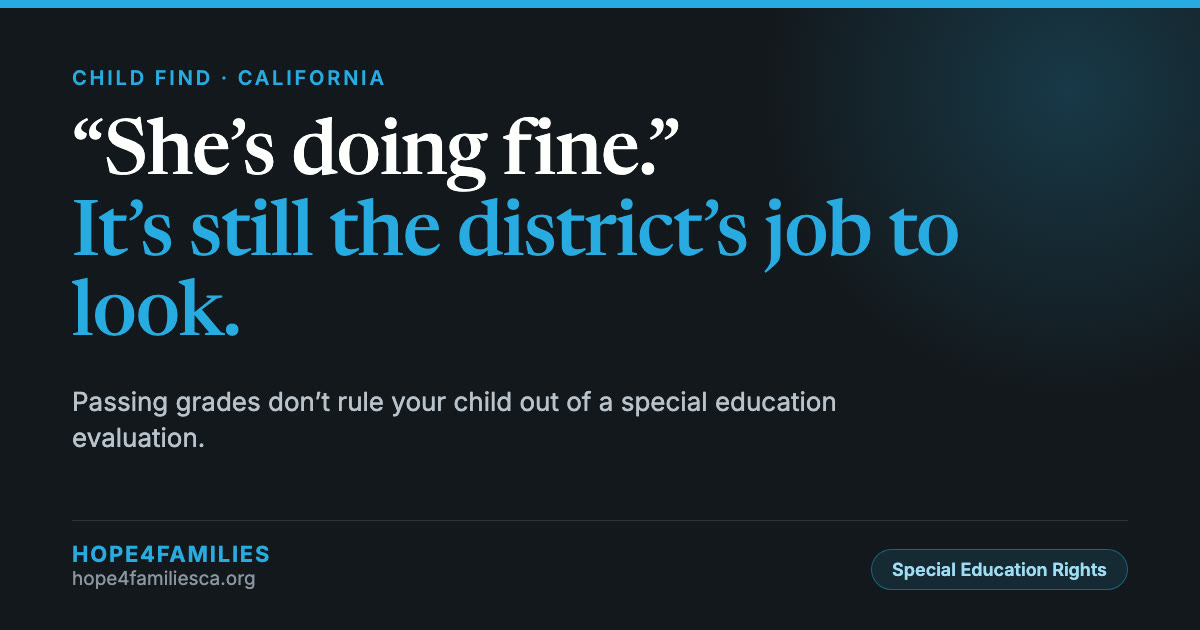
You know your child. You see the homework meltdowns, the reading that still isn’t clicking, the worry at bedtime. Then you bring it up at school and hear the same answer: “She’s doing fine.” Or, “Let’s wait and see.”
If that sounds familiar, you’re not overreacting, and you’re not alone.
Here’s the good news. Finding children who may need special education isn’t only your job. In California, the law puts that duty on the school district Cal. Ed. Code § 56300.
Watch our quick breakdown:
What is Child Find, and who does it cover?
Child Find comes from the Individuals with Disabilities Education Act (IDEA). It requires that children with disabilities who need special education be “identified, located, and evaluated” 34 CFR § 300.111(a)(1)(i). California says each school district “shall actively and systematically seek out” these children, from birth through age 21 Cal. Ed. Code § 56300.
In plain English: the district is supposed to go looking. You don’t have to prove your child needs help before anyone acts.
The duty covers a child who is suspected of having a disability and of needing special education because of it. You don’t need a diagnosis to ask. Any parent can request an initial evaluation 34 CFR § 300.301(b).
Can my child qualify for an IEP with good grades?
Yes. Child Find includes children suspected of having a disability and needing special education “even though they are advancing from grade to grade” 34 CFR § 300.111(c)(1). The same goes for services: a child with a disability who needs special education can be owed it even if they’ve never failed or been held back 34 CFR § 300.101(c)(1).
In plain English: passing grades don’t rule your child out. They don’t rule your child in, either. A child qualifies when an evaluation shows they have one of the disabilities listed in the law and, because of it, need special education 34 CFR § 300.8(a)(1).
That’s why a full evaluation matters. The school must assess your child in all areas related to the suspected disability, including, when appropriate, social and emotional skills, not just reading and math 34 CFR § 300.304(c)(4); Cal. Ed. Code § 56320(f).
Hear it from one of our attorneys:
How do I ask for a special education evaluation in California?
Put it in writing. In California, a “referral for assessment” means a written request Cal. Ed. Code § 56029. An email to the principal or special education coordinator works well, because it gives you a dated copy.
If you ask out loud, school staff must offer to help you put the request in writing Cal. Code Regs., tit. 5, § 3021(a).
In plain English: a hallway conversation is a good start, but California’s timeline runs from the day the district receives your written request. Keeping a copy helps you show when that was.
What happens after I send the request?
If the district is going to assess, it must give you a written assessment plan within 15 days of receiving your request. Days between school sessions or terms, and “days of school vacation in excess of five schooldays”, don’t count. If your request arrives 10 days or less before the school year ends, the plan is due within 10 days after the next school year starts Cal. Ed. Code § 56321(a).
You then have at least 15 days to review the plan before you decide Cal. Ed. Code § 56321(c)(4). Once the district receives your signed consent, it has 60 days to decide whether your child is eligible and hold an IEP meeting, again not counting those breaks. If your request came 30 days or less before the school year ended, the IEP is due within 30 days after the next school year starts Cal. Ed. Code §§ 56043(c), 56344(a).
If the district decides not to assess, it must send you Prior Written Notice explaining what it refused and why 34 CFR § 300.503(a)(2), (b). In plain English: a “no” has to come in writing, with reasons. You can challenge that decision with a due process complaint 34 CFR § 300.507(a)(1).
Frequently asked questions
Does the school have to evaluate my child just because I asked?
Not automatically. You have the right to request an evaluation 34 CFR § 300.301(b), but the district can decline. If it does, it must explain its decision in Prior Written Notice 34 CFR § 300.503(a)(2), (b)(2).
Do I have to wait for school interventions to finish before I ask?
No. You can request an initial evaluation while interventions are going on 34 CFR § 300.301(b). In California, your written request is a referral for assessment Cal. Ed. Code § 56029. If the district agrees to assess, it generally must send an assessment plan within 15 days, not counting certain school breaks. If it refuses, it must send Prior Written Notice explaining why Cal. Ed. Code § 56321(a); 34 CFR § 300.503(a)(2), (b)(2).
Does Child Find cover babies and toddlers?
Yes. California’s duty covers children from birth through age 21 Cal. Ed. Code § 56300. For children under 3, California’s early intervention program is called Early Start.
What you can do this week
- Write down what you’re seeing. Note dates, examples, and anything teachers have said.
- Email the school asking for a special education assessment. Name every area you’re worried about, such as reading, attention, behavior, or speech.
- Save the sent email and mark your calendar. Count 15 days from when the school received it. Days between school sessions or terms, and “days of school vacation in excess of five schooldays”, don’t count. You can agree in writing to give the school more time.
- Read the assessment plan before you sign. Check that it covers every concern you raised. You have at least 15 days to decide.
- If the answer is no, ask for Prior Written Notice. A short reply works: “Could you please send Prior Written Notice for the decision not to assess?”
- Keep everything in one folder. Emails, report cards, work samples, and meeting notes.
Trusting your instincts isn’t overreacting. It’s advocacy. You don’t need a diagnosis, the right vocabulary, or all the answers before you ask. One clear, written request is enough to get things moving.
If you’re not sure where to start, our team at Hope4Families can help. Schedule a consultation
This post is for informational purposes and does not constitute legal advice. Every child’s situation is unique. If you have specific concerns about your child’s IEP, please contact our office to discuss your options.
Not sure where to start with your child’s IEP?
Our team helps California families at no cost, from the first conversation through representation.