Prior Written Notice: What to Do When the School Says No to Your IEP Request
Hope4Families6 min read
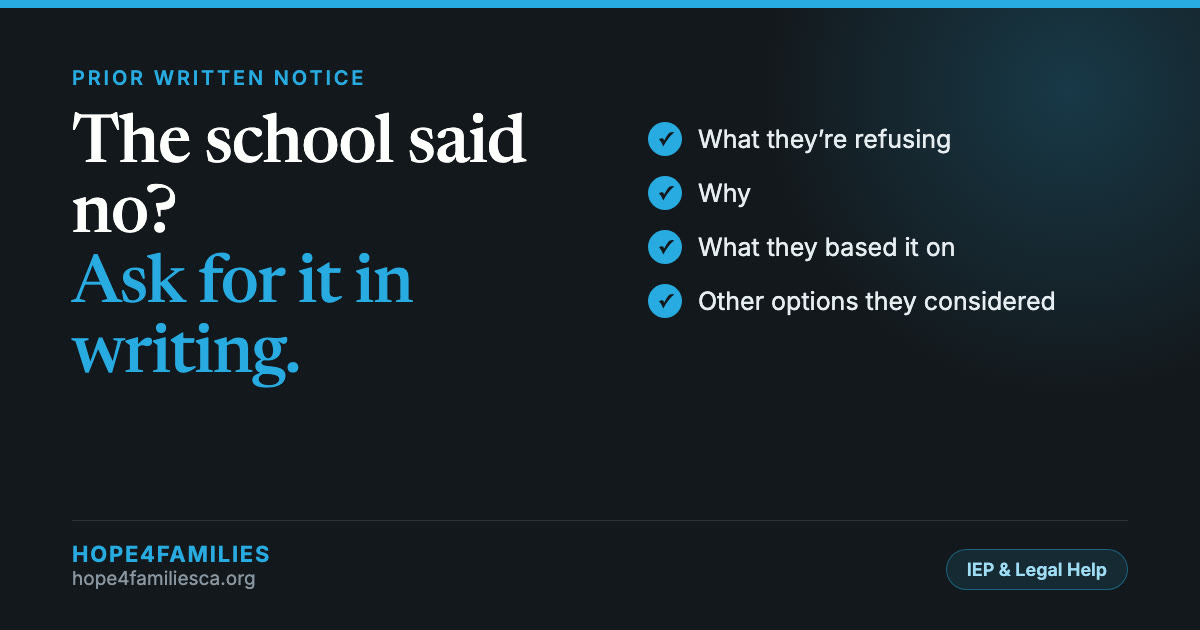
Quick answer: A school must give you Prior Written Notice a reasonable time before it proposes, or refuses, to start or change your child’s identification, evaluation, placement, or special education services 34 CFR § 300.503(a). Among other things, the notice must explain what the school is proposing or refusing, why, what it based the decision on, and what other options it considered 34 CFR § 300.503(b).
You asked for something for your child. More speech therapy. An assessment. A different classroom. And the answer was no. Maybe it came in a hallway, a quick phone call, or a single line in an email.
A “no” isn’t always the end of the conversation. When a school turns down a request like this, the law says it has to explain itself in writing. That document is called Prior Written Notice, and it’s one of the most useful tools a parent has.
Watch our quick breakdown:
What is Prior Written Notice?
Prior Written Notice (PWN) is a written explanation the school must give you a reasonable time before it proposes, or refuses, to start or change your child’s identification, evaluation, educational placement, or free appropriate public education 34 CFR § 300.503(a). California has the same rule, and also requires notice when a child is first referred for assessment Cal. Ed. Code § 56500.4(a).
In plain English: when the school says yes or no to starting or changing your child’s identification, evaluation, placement, or services, it has to put that in writing. That includes refusals, not just changes the school wants to make.
What has to be in the notice?
The notice must cover seven things 34 CFR § 300.503(b); Cal. Ed. Code § 56500.4(b):
- What the school is proposing or refusing to do
- Why
- Each evaluation procedure, assessment, record, or report it used as a basis for the decision
- A statement that you have protections under the procedural safeguards and, unless the notice is for an initial referral, how to get a copy of them
- Where you can go for help understanding your rights
- Other options the team considered, and why they were rejected
- Any other factors relevant to the decision
It must also be written in language the general public can understand, and provided in your native language or other mode of communication you use, unless that’s clearly not feasible 34 CFR § 300.503(c)(1).
In plain English: “We don’t think it’s needed” isn’t enough. The notice should show the reasons and the information behind them.
Hear it from one of our attorneys:
When should I ask for Prior Written Notice?
Any time the school proposes or refuses something about your child’s identification, evaluation, placement, or services. For example:
- You asked for a special education assessment, and the school declined.
- The team wants to reduce or end a service.
- You asked for more support or a different placement, and the answer was no.
- The school wants to change your child’s eligibility.
A short, friendly email works: “Thank you for meeting with me. Could you please send Prior Written Notice for the decision not to [assess / add the service / change the placement]?”
The rules don’t set a number of days for the notice. They say “a reasonable time” 34 CFR § 300.503(a). Asking in writing gives you a dated record.
What if the school never sent one?
Missing notice is a procedural problem you can raise. It doesn’t automatically mean your child was denied a free appropriate public education. A hearing officer can find a denial only if the procedural violation impeded your child’s right to that education, significantly impeded your chance to take part in decisions about it, or caused a loss of educational benefit 34 CFR § 300.513(a)(2); Cal. Ed. Code § 56505(f)(2). Even when it doesn’t, a hearing officer can still order the school to follow the procedural rules 34 CFR § 300.513(a)(3).
In plain English: the notice protects your right to take part. If you never got one, write down what changed and when.
If you disagree with the decision itself, you can ask for mediation 34 CFR § 300.506 or file a due process complaint 34 CFR § 300.507(a)(1). If you believe the school broke a special education rule, such as not sending required notice, you can also file a signed, written complaint with the state, as long as the violation happened no more than one year before the state receives it 34 CFR § 300.153.
Frequently asked questions
Does the school have to send notice when it agrees with me?
Yes, if the school is agreeing to start or change something about your child’s identification, evaluation, placement, or services. Saying yes to your request means the school is proposing that action, and proposals need notice just like refusals do 34 CFR § 300.503(a)(1).
Can I get Prior Written Notice in Spanish?
The notice must be in your native language, or other mode of communication you use, unless that’s clearly not feasible 34 CFR § 300.503(c)(1)(ii).
Does Prior Written Notice have to be a separate letter?
Not always. The U.S. Department of Education has said a school can use the IEP as part of the notice, as long as what you receive covers all seven required items 71 Fed. Reg. 46,691 (Aug. 14, 2006).
How long does the school have to send it?
There’s no set number of days. The notice must come “a reasonable time” before the school acts 34 CFR § 300.503(a).
What you can do this week
- After a “no” about your child’s evaluation, eligibility, placement, or services, send a short email asking for Prior Written Notice.
- Check the notice against the seven items. Is anything missing?
- Ask for the reports or data it relied on. In California, you can get copies of school records within five business days of asking Cal. Ed. Code § 56504.
- Reply in writing if something’s missing. Ask politely for the missing pieces.
- Keep a folder with your requests, the school’s answers, and the dates.
- If your child already has an IEP and you still disagree, ask in writing for an IEP meeting. In California, the school must hold a meeting to review the IEP within 30 days of receiving your written request, not counting days between regular school sessions or terms, or “days of school vacation in excess of five schooldays” Cal. Ed. Code § 56343.5.
Asking for Prior Written Notice isn’t confrontational. It’s simply asking the school to show its thinking, and it helps everyone at the table stay clear on what was decided and why.
If the school’s answer doesn’t sit right with you, our team at Hope4Families can help. Schedule a consultation
This post is for informational purposes and does not constitute legal advice. Every child’s situation is unique. If you have specific concerns about your child’s IEP, please contact our office to discuss your options.
Not sure where to start with your child’s IEP?
Our team helps California families at no cost, from the first conversation through representation.