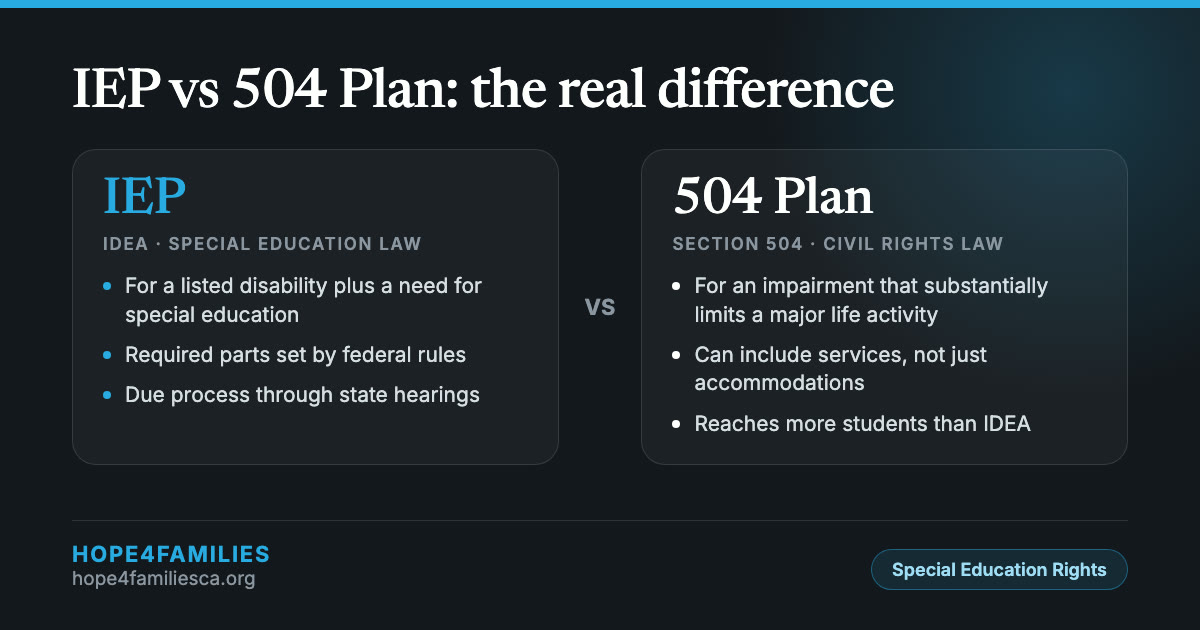
Quick answer: An IEP comes from IDEA, the federal special education law, and is for students who have a qualifying disability and need special education because of it 34 CFR § 300.8(a)(1). A 504 plan comes from Section 504 of the Rehabilitation Act, a civil rights law that protects a broader group of students with disabilities 34 CFR § 104.3(j). Which one fits depends on what your child needs.
Maybe the school said your child doesn’t qualify for an IEP, but they can offer a 504 plan. Or you’re trying to figure out which one to ask for. Either way, people use the two terms like they mean the same thing.
They don’t. They come from different laws, cover different students, and carry different protections. Knowing the difference helps you ask better questions.
Watch our quick breakdown:
What is an IEP, and who qualifies?
An IEP, or Individualized Education Program, is a written plan for a child with a disability under IDEA 34 CFR § 300.22. To qualify, your child must be evaluated and found to have one of the disabilities listed in the federal rules, such as autism, a specific learning disability, or an other health impairment, and, because of it, need special education and related services 34 CFR § 300.8(a)(1).
In plain English: a diagnosis alone isn’t enough. The evaluation has to show your child meets one of the listed disability definitions and needs special education because of it.
Special education means specially designed instruction, at no cost to you, to meet your child’s unique needs 34 CFR § 300.39(a)(1). Every IEP must include certain parts, like your child’s present levels of performance, measurable annual goals, and the services the school will provide 34 CFR § 300.320(a).
What is a 504 plan, and who qualifies?
It says a qualified student with a disability can’t be excluded from, denied the benefits of, or discriminated against in a federally funded program solely because of their disability 29 U.S.C. § 794(a). That includes public school districts 29 U.S.C. § 794(b)(2)(B).
It protects a student with a physical or mental impairment that substantially limits one or more major life activities, such as learning, concentrating, or thinking 34 CFR § 104.3(j); 42 U.S.C. § 12102(2).
In plain English: Section 504 reaches more students than IDEA. Your child doesn’t have to need specially designed instruction to be protected.
Is a 504 plan just accommodations?
Not necessarily. Under Section 504, an appropriate education can include “regular or special education and related aids and services” designed to meet your child’s needs as adequately as the needs of students without disabilities are met 34 CFR § 104.33(b)(1).
In plain English: a 504 plan can go beyond extra time and preferential seating, if that’s what your child needs.
IDEA spells out what an IEP must contain and who must be on the IEP team 34 CFR §§ 300.320(a), 300.321(a). Section 504 requires an evaluation 34 CFR § 104.35(a), placement decisions made by a group that includes people who know your child, the evaluation results, and the placement options 34 CFR § 104.35(c)(3), and procedural safeguards 34 CFR § 104.36. But unlike IDEA, the Section 504 school rules don’t list required parts for a written plan 34 CFR §§ 104.31 to 104.39.
What can I do if I disagree with the school?
Under IDEA, you can file a due process complaint about your child’s identification, evaluation, or placement, or whether your child is getting a free appropriate public education 34 CFR § 300.507(a)(1). In California, the Office of Administrative Hearings currently hears these cases. You can also ask for mediation 34 CFR § 300.506, or, if you believe the district broke a special education rule, file a signed written complaint with the California Department of Education within one year of the violation 34 CFR § 300.153(a)-(c).
Under Section 504, for disagreements about your child’s identification, evaluation, or placement, the district’s safeguards must include an impartial hearing where you can take part and be represented by a lawyer 34 CFR § 104.36. You can also file a written complaint with the U.S. Department of Education’s Office for Civil Rights, generally within 180 days of the alleged discrimination unless OCR extends the deadline 34 CFR §§ 104.61, 100.7(b).
In plain English: if the school offers a 504 plan and you believe your child needs special education, that doesn’t have to be the final word. You can ask for an evaluation under IDEA 34 CFR § 300.301(b). In California, make that request in writing Cal. Ed. Code § 56029.
Frequently asked questions
Can my child have both an IEP and a 504 plan?
Usually there’s no need for both. Carrying out an IEP developed under IDEA is one way a school can meet Section 504’s standard for an appropriate education 34 CFR § 104.33(b)(2).
My child has ADHD. Should we ask for an IEP or a 504 plan?
It depends on your child’s needs, not the diagnosis alone. ADHD is named in IDEA’s definition of “other health impairment.” It counts when it limits your child’s strength, vitality, or alertness (including being overly alert to everything around them) in a way that limits their alertness for learning, and it adversely affects their educational performance 34 CFR § 300.8(c)(9). Your child also has to need special education because of it 34 CFR § 300.8(a)(1). Even if your child doesn’t qualify for an IEP, Section 504 may still apply if ADHD substantially limits a major life activity, such as learning, concentrating, or thinking 29 U.S.C. § 705(20)(B); 42 U.S.C. § 12102(2).
Can the school move my child from an IEP to a 504 plan?
Not without following the rules. Before deciding your child no longer qualifies under IDEA, the district must evaluate your child 34 CFR § 300.305(e)(1). It must also give you Prior Written Notice of the change 34 CFR § 300.503(a).
What you can do this week
- Ask which law the school considered. Ask in writing whether your child was evaluated for an IEP, and why the team chose a 504 plan.
- Request copies of the evaluation reports. In California, you can get copies of your child’s school records within five business days of asking Cal. Ed. Code § 56504.
- List every area where your child struggles, from reading and focus to behavior and friendships, then check that the plan addresses each one.
- If you think your child needs special education, ask for an IDEA evaluation in writing. If the school says no, it must give you Prior Written Notice explaining why 34 CFR § 300.503(a)(2).
Whether your child ends up with an IEP or a 504 plan, the goal is the same: support that matches what your child needs.
If the school offered a 504 plan and you believe your child needs more, our team at Hope4Families can help. Schedule a consultation
This post is for informational purposes and does not constitute legal advice. Every child’s situation is unique. If you have specific concerns about your child’s IEP, please contact our office to discuss your options.
Not sure where to start with your child’s IEP?
Our team helps California families at no cost, from the first conversation through representation.