Agree With Most of the IEP, but Not All of It? You Can Consent to Part of It in California
Hope4Families5 min read
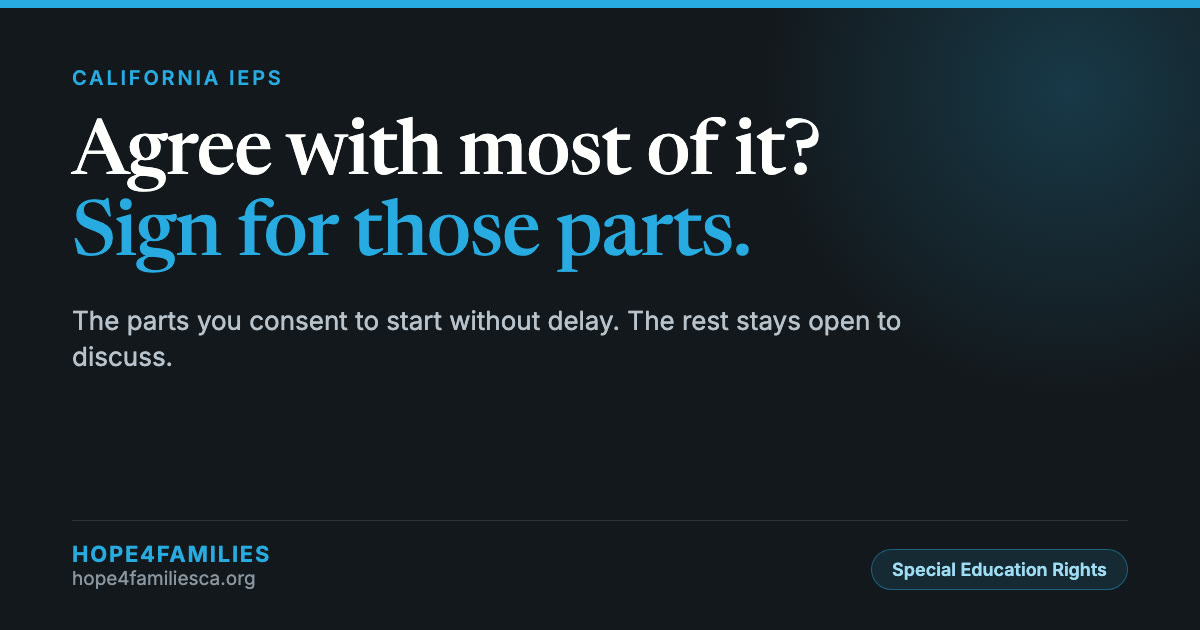
Quick answer: In California, if you consent in writing to special education and related services but don’t agree to every part of the IEP, the parts you agree to must be put in place so your child’s instruction and services aren’t delayed Cal. Ed. Code § 56346(e). If the district decides a part you didn’t agree to is necessary for a free appropriate public education, a due process hearing must be started Cal. Ed. Code § 56346(f).
You’re handed a long IEP at the end of a long meeting. Most of it looks right. The goals are better than last year. But speech minutes were cut, or a placement change appeared on page 12, and you don’t agree with it.
Many parents feel like they have two choices: sign everything or sign nothing. In California, there’s a third option.
Watch our quick breakdown:
What does it mean to consent to part of an IEP?
If you’ve consented in writing to special education and related services, you can agree to some parts of the IEP and not others. The parts you agree to must be implemented so your child’s instruction and services aren’t delayed Cal. Ed. Code § 56346(e).
Consent must be informed, voluntary, and in writing 34 CFR § 300.9.
In plain English: you can say yes to the parts that help your child now, and keep talking about the parts you disagree with.
A practical tip: make it clear, in writing, exactly which parts you consent to and which you don’t. Specific beats general.
What happens to the parts I don’t agree with?
If the district decides a part you didn’t agree to is necessary for your child to receive a free appropriate public education, a due process hearing must be initiated. While a resolution session, mediation, or hearing is pending, your child stays in the current placement, unless you and the district agree otherwise Cal. Ed. Code § 56346(f).
You also have options of your own. You can ask for another IEP meeting Cal. Ed. Code § 56343(c), ask for mediation 34 CFR § 300.506, or file for due process yourself 34 CFR § 300.507(a)(1).
In plain English: if you consent in writing to the rest, disagreeing with one part doesn’t hold up the parts you agreed to, and it doesn’t end the conversation.
Is it different for a first IEP?
Yes, if you say no to services altogether. Before a district provides special education services for the first time, it must get your informed, written consent 34 CFR §§ 300.9(b), 300.300(b)(1). California law requires the district to seek that consent first Cal. Ed. Code § 56346(a). If you refuse or don’t respond, the district can’t use mediation or due process to start those services, it won’t be found to have denied your child a free appropriate public education for them, and it doesn’t have to hold an IEP meeting or write an IEP for them 34 CFR § 300.300(b)(3); Cal. Ed. Code § 56346(b)-(c).
Partial consent works at a first IEP too. If you consent in writing to special education and related services but not to every part of the IEP, the parts you agree to must be implemented Cal. Ed. Code § 56346(e). The due process step in § 56346(f) doesn’t apply to a parent who refused or didn’t respond to consent for initial services Cal. Ed. Code § 56346(f).
In plain English: for a first IEP, saying no to services entirely has different effects than saying yes with exceptions.
Frequently asked questions
Do I have to sign the IEP at the meeting?
The consent rules don’t set a signing deadline. Consent has to be informed, voluntary, and in writing 34 CFR § 300.9; Cal. Ed. Code § 56021.1. Waiting does have effects: for a first IEP, services can’t start until you consent.
Can I take back consent for just one service?
Revoking consent in writing ends all special education and related services, not just one 34 CFR § 300.300(b)(4); Cal. Ed. Code § 56346(d). If you disagree with one service, you can ask for an IEP meeting to review or revise the IEP Cal. Ed. Code § 56343(c), or use the dispute options above.
Will my child lose services while we work out the disagreement?
The parts you consented to must be implemented Cal. Ed. Code § 56346(e). For the disputed part, your child stays in the current placement while a resolution session, mediation, or hearing is pending, unless you and the district agree otherwise Cal. Ed. Code § 56346(f).
What you can do this week
- Read the full IEP before signing, including the services page and any placement change.
- List the parts you agree with and the parts you don’t.
- Put it in writing clearly. Use the district’s consent form, attach a written explanation if needed, and ask for a copy showing exactly what you agreed to. For example: “I consent to the IEP except the reduction in speech services and the change in placement.”
- Ask for Prior Written Notice of any change the district proposes or refuses. It must explain why 34 CFR § 300.503(a), (b)(2); Cal. Ed. Code § 56500.4.
- Ask for a follow-up meeting if you think the disagreement can be worked out.
Partial consent is a way to protect your child’s progress while you keep advocating. You don’t have to choose between your child’s services and your concerns.
If you’re stuck on part of the IEP and not sure what to do next, our team at Hope4Families can help. Schedule a consultation
This post is for informational purposes and does not constitute legal advice. Every child’s situation is unique. If you have specific concerns about your child’s IEP, please contact our office to discuss your options.
Not sure where to start with your child’s IEP?
Our team helps California families at no cost, from the first conversation through representation.