
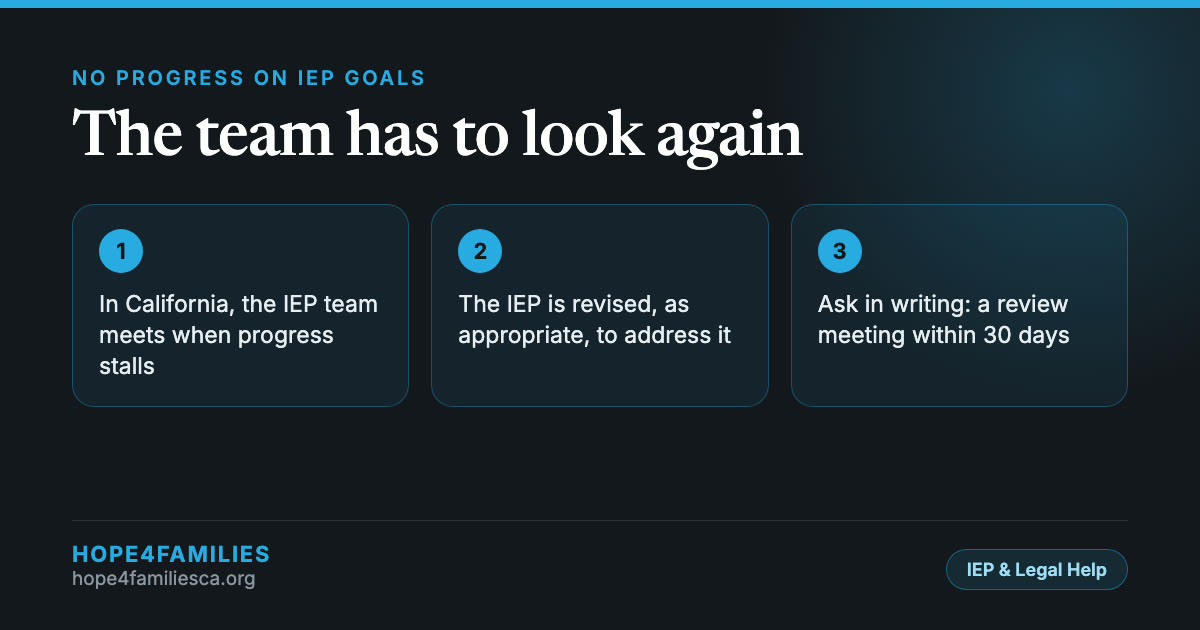
Quick answer: In California, the IEP team must meet whenever a student shows a lack of anticipated progress Cal. Ed. Code § 56343(b). The team must also revise the IEP, as appropriate, to address any lack of expected progress toward the annual goals 34 CFR § 300.324(b)(1)(ii)(A). You can ask for a meeting in writing, and the school must hold a meeting to review the IEP within 30 days of receiving your written request, not counting certain school breaks Cal. Ed. Code § 56343.5.
The progress report looks familiar. Same goals as last year. Same “emerging” or “partially met.” Maybe the same reading level as last spring. You ask how it’s going and hear, “We’re working on it.”
When the IEP stays the same and your child isn’t moving forward, it’s natural to wonder whether anyone is going to change the plan. The good news is that the law expects the team to act on a lack of progress, and you can start that conversation yourself.
Watch our quick take on what “appropriate” means:
What does the law say should happen when there’s no progress?
The IEP team must review your child’s IEP at least once a year to see whether the annual goals are being met. It must revise the IEP, as appropriate, to address any lack of expected progress 34 CFR § 300.324(b)(1). California adds that the team must meet whenever a student demonstrates a lack of anticipated progress Cal. Ed. Code § 56343(b).
In plain English: a lack of progress is a reason to meet and look at the plan again, not something to wait out until the annual review.
The law doesn’t spell out what a revision should look like. It says the team revises the plan “as appropriate.” Depending on your child, that could mean new goals, more service time, a different teaching approach, or new assessments.
How is “progress” measured?
The Supreme Court has said a school must offer an IEP reasonably calculated to enable a child to make progress appropriate in light of the child’s circumstances (Endrew F. v. Douglas County School Dist. RE-1, 580 U.S. 386, 399 (2017)). That’s not a promise of the best possible program, but the Court said its standard is “markedly more demanding than the 'merely more than de minimis’ test” (580 U.S. at 402).
In plain English: the question is what progress is appropriate for your child, given your child’s own circumstances. More on that in our post on how appropriate progress is measured.
The IEP itself must describe how progress toward the annual goals will be measured, and when periodic progress reports will be provided, such as quarterly reports issued with report cards 34 CFR § 300.320(a)(3). Those reports are a good place to start when you ask for a change.
How do I ask for an IEP meeting about lack of progress?
Put it in writing. In California, a parent can ask for a meeting to review or revise the IEP Cal. Ed. Code § 56343(c). A meeting to review the IEP must be held within 30 days of the district receiving your written request. The 30 days don’t include days between your child’s regular school sessions or terms, or “days of school vacation in excess of five schooldays.” If you ask out loud, the district must tell you a written request is needed and how to file one Cal. Ed. Code § 56343.5.
You can also ask for a reassessment 34 CFR § 300.303(a)(2). It can help when the team needs better information about what’s getting in the way. A reassessment can’t happen more than once a year unless you and the district agree otherwise 34 CFR § 300.303(b)(1).
In plain English: you don’t have to wait for the school to bring it up.
What if the team won’t change anything?
If the school refuses a change you asked for in your child’s evaluation, placement, or services, it must give you Prior Written Notice that explains why 34 CFR § 300.503(a)(2), (b)(2). If you still disagree, you can ask for mediation or file a due process complaint 34 CFR §§ 300.506, 300.507(a)(1). In California, a due process complaint generally must be filed within two years of when you knew or had reason to know the facts behind it Cal. Ed. Code § 56505(l).
Frequently asked questions
Is it automatically a violation if the IEP goals stay the same every year?
Not automatically. The rules don’t ban repeating a goal. They require the team to review the IEP at least once a year and revise it, as appropriate, to address a lack of expected progress 34 CFR § 300.324(b)(1). Whether a plan denied your child an appropriate education depends on the facts, measured by the Endrew F. standard.
Do I have to wait for the annual IEP meeting?
No. In California, the team must meet when a student shows a lack of anticipated progress, and a parent can ask for a meeting to review the IEP at any time Cal. Ed. Code § 56343(b)-(c).
Can I ask for a new assessment?
Yes. A parent can request a reassessment 34 CFR § 300.303(a)(2). It can’t happen more than once a year unless you and the district agree otherwise 34 CFR § 300.303(b)(1).
What you can do this week
- Line up the last few progress reports side by side. Look for goals that haven’t moved.
- Write down what you see at home, and anything teachers have told you.
- Email a written request for an IEP meeting to review the IEP because of a lack of progress. Keep the sent email.
- Ask the team how it will address the lack of progress. New goals, more minutes, a different method, or a new assessment?
- Ask for Prior Written Notice of any decision not to change the plan.
You know your child’s starting point better than anyone. Bringing that knowledge to the table, with the progress reports in hand, is one of the most effective things a parent can do.
If the plan isn’t changing and you’re not sure what to do next, our team at Hope4Families can help. Schedule a consultation
This post is for informational purposes and does not constitute legal advice. Every child’s situation is unique. If you have specific concerns about your child’s IEP, please contact our office to discuss your options.
Not sure where to start with your child’s IEP?
Our team helps California families at no cost, from the first conversation through representation.