
Can a Child With an IEP Be Suspended or Expelled? What California Parents Should Know
Hope4Families6 min read
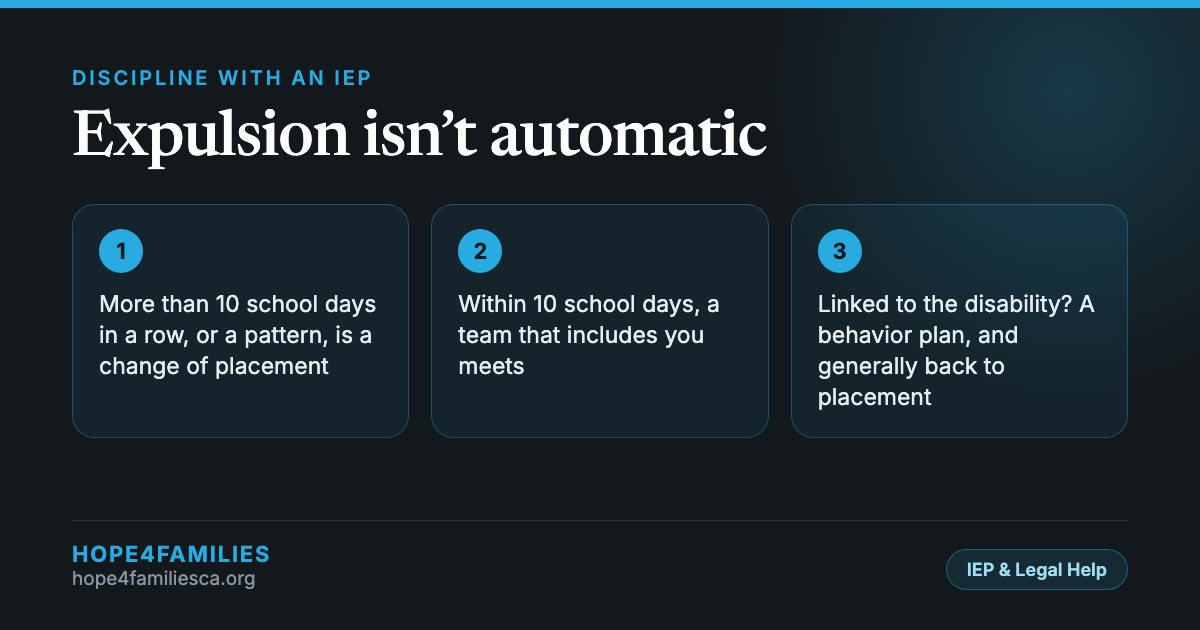
Quick answer: A child with an IEP can be disciplined, but expulsion isn’t automatic. Within 10 school days of a decision to change your child’s placement for breaking a conduct rule, a team that includes you must decide whether the behavior was caused by, or directly and substantially related to, the disability, or was the direct result of the school not following the IEP 34 CFR § 300.530(e). If so, your child generally returns to their placement and the team addresses the behavior 34 CFR § 300.530(f).
It’s the call no parent wants: your child got in trouble at school, and now someone is saying “suspension” or “expulsion.”
Take a breath. If your child has an IEP, the law gives them specific discipline protections.
Watch our quick breakdown:
When do the IEP discipline protections kick in?
Under federal rules, a school can remove a student with a disability for up to 10 school days in a row, to the same extent it would remove a student without a disability 34 CFR § 300.530(b)(1). California sets a tighter limit: a principal can generally suspend a student for no more than five school days in a row Cal. Ed. Code § 48911(a).
The bigger protections start when discipline becomes a change of placement. That happens when a removal lasts more than 10 school days in a row, or when a series of removals forms a pattern 34 CFR § 300.536(a). A pattern means the removals total more than 10 school days in a school year, the behavior is substantially similar each time, and other factors, like how close together the removals were, point the same way. You can challenge the district’s call through due process 34 CFR § 300.536(b).
In plain English: several short suspensions can add up, so keep a list of the dates.
What happens at a manifestation determination meeting?
Within those 10 school days, the district, you, and relevant IEP team members (chosen by you and the district) review your child’s file, including the IEP, teacher observations, and any relevant information you bring 34 CFR § 300.530(e)(1).
The team answers two questions:
- Was the behavior caused by, or directly and substantially related to, your child’s disability?
- Was the behavior the direct result of the school not following the IEP?
If the answer to either one is yes, the behavior is treated as a manifestation of your child’s disability 34 CFR § 300.530(e)(2). If the team finds the behavior was the direct result of the IEP not being followed, the district must take immediate steps to fix that 34 CFR § 300.530(e)(3).
In plain English: you’re part of this decision, and what you know about your child counts.
What if the behavior is linked to my child’s disability?
If your child doesn’t have a behavior plan yet, the IEP team must do a functional behavioral assessment (unless the district already did one before the incident) and put a behavior plan in place. If your child already has a behavior plan, the team reviews it and changes it as needed 34 CFR § 300.530(f)(1). Your child also returns to the placement they were removed from, unless you and the district agree to a change as part of updating the behavior plan 34 CFR § 300.530(f)(2).
One exception: if, at school or a school event, your child carried or had a weapon, knowingly had or used illegal drugs, sold or tried to sell a controlled substance, or inflicted serious bodily injury on another person (as federal law defines it), the school can place your child in an interim alternative setting for up to 45 school days, whether or not the behavior was linked to the disability 34 CFR § 300.530(g), (i).
If it isn’t linked, the school can discipline your child the same way it would any student. But your child must keep receiving educational services, even if in another setting, so they can keep participating in the general curriculum and working toward their IEP goals 34 CFR § 300.530(c), (d)(1). California follows these federal rules for students with IEPs Cal. Ed. Code § 48915.5(a), (b).
How can the IEP help before the next incident?
If your child’s behavior gets in the way of their learning or other students’ learning, the IEP team must consider positive behavioral interventions and supports, and other strategies, to address it 34 CFR § 300.324(a)(2)(i); Cal. Ed. Code § 56341.1(b)(1).
In plain English: you can ask the team to talk about supports, not just consequences.
Why behavior belongs in the IEP:
Frequently asked questions
What if I disagree with the manifestation decision?
You can appeal by requesting a due process hearing. Discipline appeals are expedited: the hearing must happen within 20 school days of filing, with a decision within 10 school days after it 34 CFR § 300.532(a), (c)(2). During the appeal, your child stays in the interim setting until the decision or the end of the removal period, whichever comes first, unless you and the district agree otherwise 34 CFR § 300.533.
My child doesn’t have an IEP yet. Do these protections apply?
They can, if the law treats the school as already knowing about your child’s disability before the behavior 34 CFR § 300.534(a). That includes when you told your child’s teacher or a school administrator in writing that your child needs special education, you asked for an evaluation, or staff raised specific concerns about a pattern of behavior with the special education director or another supervisor 34 CFR § 300.534(b). There are exceptions, such as if you didn’t allow an evaluation or your child was evaluated and found not eligible 34 CFR § 300.534(c).
Will my child still get services during a suspension?
It depends on how many school days your child has been removed this school year. For the first 10, the school must provide services only if it does so for students without disabilities who are removed 34 CFR § 300.530(d)(3). After that, the school must provide services during later removals, to the extent the rules require. For a short removal, school staff and at least one of your child’s teachers decide what’s needed. For a change of placement, the IEP team decides 34 CFR § 300.530(b)(2), (d)(4)-(5).
What you can do this week
- Ask in writing what’s being proposed, and for how many school days. For a change of placement, the school must notify you the day it decides and give you your procedural safeguards 34 CFR § 300.530(h).
- Bring what you know: what happened before the incident, and what helps at home.
- Ask whether the IEP was being followed, and if not, whether that led to the behavior.
You don’t have to face a discipline decision alone. If the school is moving toward a long suspension or expulsion, our team at Hope4Families can help. Schedule a consultation
This post is for informational purposes and does not constitute legal advice. Every child’s situation is unique. If you have specific concerns about your child’s IEP, please contact our office to discuss your options.
Not sure where to start with your child’s IEP?
Our team helps California families at no cost, from the first conversation through representation.